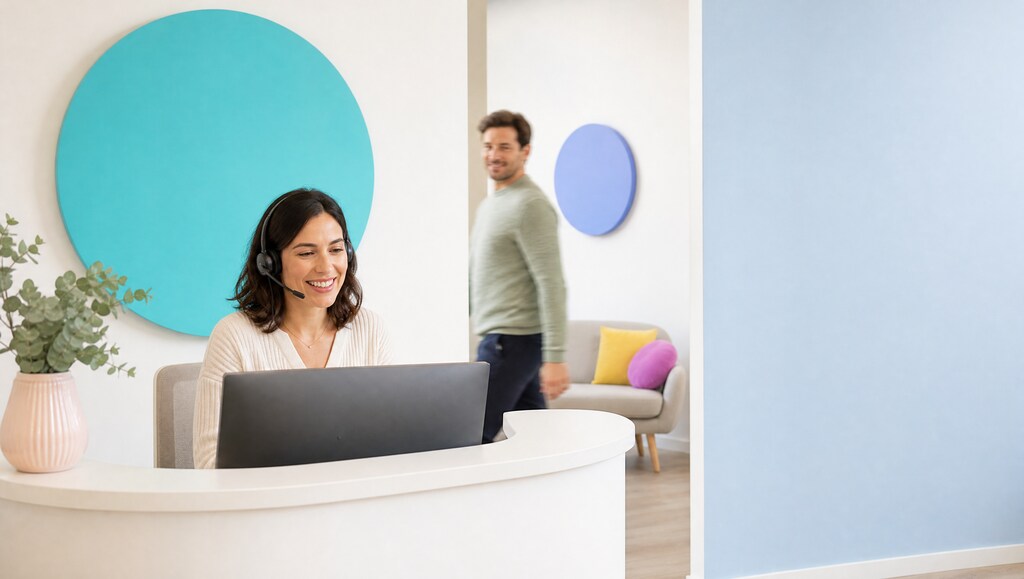
In smaller EAPs, the phone is still the front door. A handful of consultants take incoming calls, the caller goes to whoever is free, and a front desk keeps it all moving. When the conversation turns to an employee app, the consultants' first reaction is often worry about how many doors a small team can keep open at once: phone, website chat, app bookings and email.
Within the EAP space, one of the topics surfacing at the moment is whether EAP self-service booking suits a triage model at all, or whether it only works for large providers with deep clinician panels.
EAP self-service booking can sit alongside a call-led triage model, but it doesn't need to be switched on all at once. Many smaller EAPs start with staff-controlled booking, where the front desk books into consultants' calendars on the employee's behalf, then add employee self-booking later for specific services or employer clients.
Their capacity is small and everyone can see it. When a small team is covering every incoming call, a slot booked through the app is a slot that can't take the next urgent call.
The first-available model also works. It gets distressed callers to a person quickly, and the front desk acts as a switchboard that weighs urgency, employer contract and consultant skills in real time. Consultants worry, reasonably, that bookings arriving through an app, a website form and a chat window will fragment their day and bypass that judgement.
They lose the moment they decided to ask for help. Employees often make that decision late at night, and if the only option is calling during business hours, the impulse to reach out can fade by the next morning.
Phone-only intake also filters out people who avoid phone calls, including plenty of employees who'd happily type a request but won't ring. Neither group shows up in your utilisation numbers, and utilisation is what employers judge you on. Giving those employees a written route in, even one that still lands with your front desk, captures demand you're currently missing.
The app becomes another route to your front desk, and your operations team books on the employee's behalf. A typical setup looks like this:
Nothing changes about who decides where a call goes. What changes is that every booking, reminder and session record now sits in one place rather than across a phone log, a calendar and an inbox.
Switch it on where demand is predictable and capacity can be protected. A few common starting points:
Review after a quarter. If the front desk is still rebooking most app requests, the services you opened were the wrong ones. If app bookings are steady and consultants still have room for urgent calls, open the next service or employer. Some EAPs also keep a daily block of unbookable time for each consultant, so triage calls always have somewhere to go however busy the app gets.
Wellifiy, a white-label platform for EAP providers, lets each employer client have its own app configuration, so self-booking can be on for one employer and off for another. Staff book into consultants' calendars with two-way Google and Outlook sync, quotas track session allowances against each employer contract, and reminders and in-app video run automatically. Case notes, roles and permissions keep clinical and administrative work separate. See our appointments and scheduling features or the EAP platform overview.
For more on setting up your app around bookings, read how to design an EAP app that drives counselling bookings, or compare options in our complete guide to choosing an EAP platform.
Wellifiy lets EAPs control booking by employer client, with front-desk scheduling into consultants' calendars, two-way Google and Outlook sync, and quotas that track each employer's session allowance, so triage teams can add app access without losing control of their day. It is one part of a single platform for running and scaling a modern EAP, covering self-service intake, clinician management, automated workflows, segmented employer reporting and a fully white-labelled employee app on the Apple App Store and Google Play. Founded by Clinical Psychologist Dr Noam Dishon (PhD Clinical Psychology).